



LOUHE is excited to introduce the new Area Analysis feature, designed to transform how businesses detect potential anomalies and threats. This innovative tool, available to all Detect & Response customers with the upcoming autumn update, offers a more detailed perspective on access control data, enhancing security and operational efficiency.
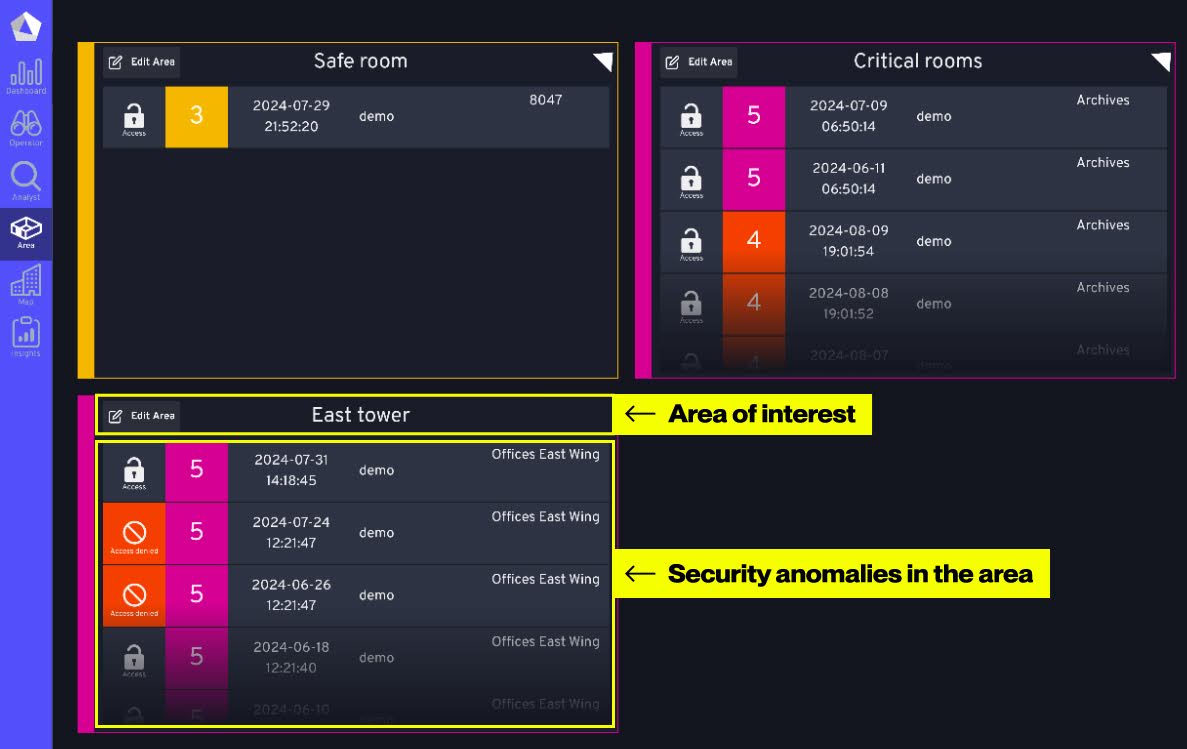
The Area Analysis feature empowers organisations to monitor critical spaces with greater precision, allowing for swift detection of any suspicious activity. By shifting the focus from access token patterns to area-based monitoring, organisations can more effectively identify potential breaches or unauthorised access, ensuring that critical spaces remain protected and enabling immediate mitigation actions when necessary.
Beyond enhancing security, this new feature also contributes to operational savings. Integrating alarm device data with access control insights helps organisations reduce unnecessary guard responses to false alarms. This not only lowers costs associated with security operations but also ensures that resources are allocated where they are needed most, improving overall efficiency.
“We are also close to encompassing alarm device data to areas. Combining the two data sources, the access control and the alarm data, enables us to find the culprit faster. Many alarms can be dismissed as false alarms bringing operational savings from fewer guard calls. Or in some cases, then raise the alarm even higher when the company’s data sources cannot explain the anomaly and a real break-in is happening.” explains CTO Hannes Huotari.
Occupational safety and security risk management are also strengthened through the Area Analysis feature. By providing a comprehensive view of activity within defined areas, organisations can better understand patterns and anomalies in people flows. This proactive approach to risk management is central to maintaining business continuity and ensuring the safety of both personnel and assets.
As businesses navigate the increasingly complex security landscape, LOUHE’s Area Analysis offers a toolset that keeps them ahead of the curve. The feature enables the detection of unusual patterns, such as activity outside normal operating hours, which could signal a potential security threat. By analysing data from different perspectives – from individual doors to entire groups of areas – LOUHE provides a more granular level of monitoring, allowing for quicker identification of anomalies and more effective responses.
The feedback from pilot programs has been very promising, with the Area Analysis feature proving to be an effective way of spotting irregularities and providing detailed insights into security events. The intuitive user interface allows for easy configuration and management of areas, while the underlying machine learning models continuously improve accuracy by learning from historical data.
“Taking the feature into use requires reanalysis of the history data so that the models for the areas can be created. After a short training in the background, the Area feature produces new types of analysis and makes LOUHE even more accurate” explains CTO Hannes Huotari.
As the feature becomes available, LOUHE will support clients in setting up and customising their area analysis models. The system’s automated training process will analyse historical data to establish baseline patterns, ensuring that the Area Analysis runs at full capacity shortly after activation.
By adopting the Area Analysis feature, organisations not only enhance their security but also make significant strides in resource allocation and reducing operational costs. This new capability underscores LOUHE’s commitment to delivering innovative solutions that meet the evolving needs of the changing security landscape.
Ready to take your security to the next level? Contact our CTO Hannes Huotari at +358 50 485 8597 or hannes.huotari@louhe.fi to learn more about how LOUHE and our new Area Analysis can benefit your organisation.